Two mountains for the morning, nothing for the afternoon.
Somerset West is one of the few Cape towns where the mountains are on the wrong side to help you. This is what that does to your windows — and what we'd fit on each wall because of it.
Most shading advice could have been written about anywhere. This wasn't. Somerset West sits at roughly 34°05′ south, about six kilometres inland from False Bay, on the Lourens River, with the Helderberg standing over it and the Hottentots Holland running away to the south-east.12 Those two facts — how far south you are, and which side the high ground is on — decide almost everything about the light in your rooms. Everything below is sourced; the list is at the bottom of the page.
Which way the mountain actually lies
Ask anyone here where the Helderberg is and they'll point roughly over their shoulder. Pinned down, the summit sits at about 34°02′ south, 18°52′ east — a shade over five kilometres from the middle of town, bearing roughly north-north-east.2 The name is Dutch for "clear mountain", and it belongs to the Hottentots Holland range, which then curves away south-east and is crossed by the N2 at Sir Lowry's Pass on its way to the Elgin valley.23
Read that as a shading problem and it's blunt. In the southern hemisphere the sun spends its whole day in the northern half of the sky, rising in the east and setting in the west. Somerset West has high ground to the north-north-east and more of it to the east and south-east — the morning side. On the western side there is the run of ground down past the Lourens River to Strand, the beach, and then the open water of False Bay, with the Cape Peninsula forty-odd kilometres away as a silhouette rather than a shadow.
The mountains here take a bite out of your morning and give you nothing back after lunch. Almost every shading rand in this town belongs on the western half of the house.
That's also why the town's houses argue with each other. A stand on the upper slopes above the golf courses is looking down and out over the bay; a stand on the flatter ground toward the Strand side is looking back up at the mountain. Same suburb, opposite problems, and the two need opposite specifications.
Sunrise gets here late
Sunrise times printed in a diary are calculated for a flat horizon. Somerset West doesn't have one. Look east from most of the town and you're looking at mountain: the Helderberg's eastern shoulder in the winter months, and in high summer the ridgeline running down toward Sir Lowry's Pass, since at this latitude the midsummer sun comes up at an azimuth of about 119° — well south of east, out over the range.4
The practical consequence is not that you get less sun. It's that you get no gentle ramp into it. On a flat-horizon coast the light builds for half an hour before it means anything. Here the sun clears a ridge already several degrees up and the room goes from grey to hard, low, straight-in glare in a couple of minutes. East-facing bedrooms and breakfast rooms in Somerset West are not a heat problem — the masonry is still cold from the night — they are a light-switch problem.
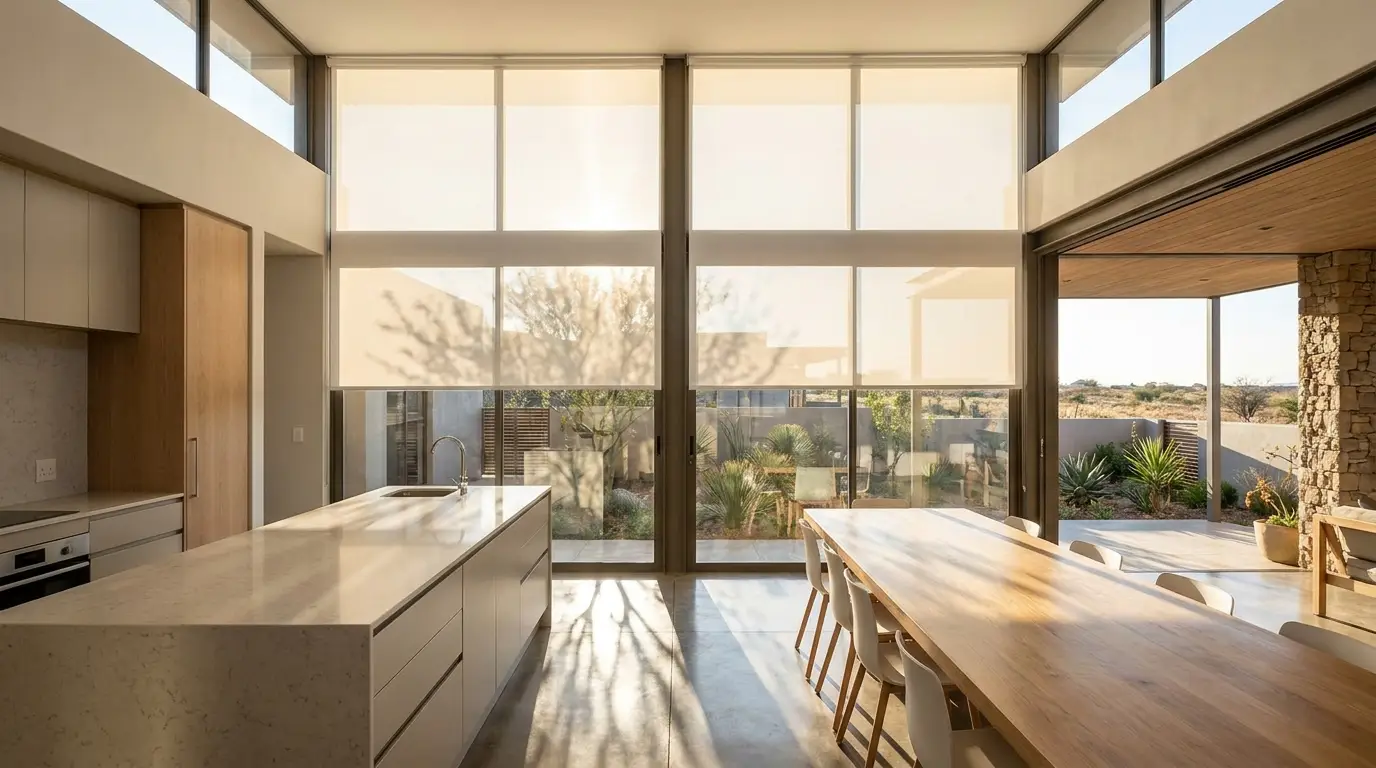
That distinction changes what we'd quote. A room that needs the glare stopped, not the heat, does not need an expensive exterior product. It needs the right fabric on the inside of the glass, and it needs it to be genuinely controllable — because on the two or three mornings a week you want that light, you'll want all of it.
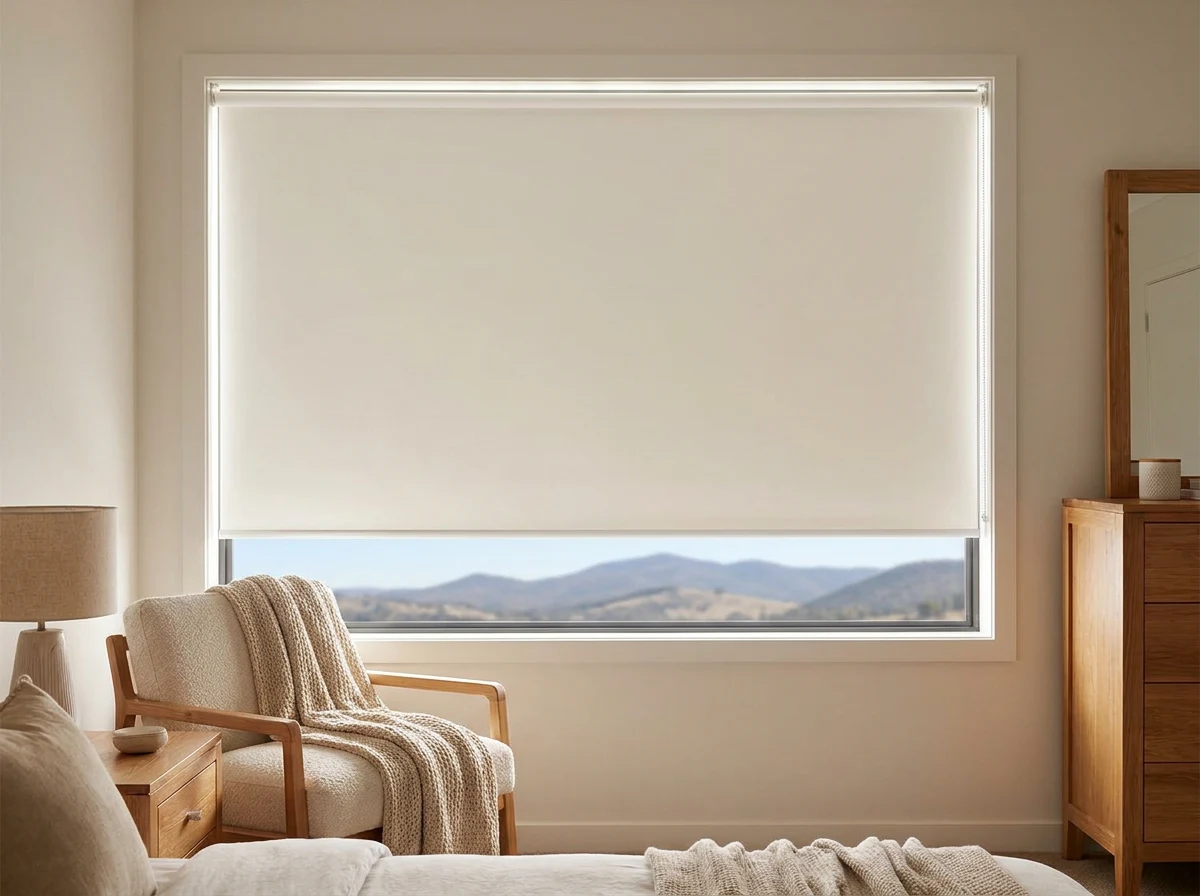
A bedroom blind earns its money in the first four minutes after the sun clears the ridge, not at noon.
Midday is the easy part
The overhead numbers are simple arithmetic once you know your latitude, and they're worth knowing because they explain why roof overhangs behave the way they do. At 34°05′ south, with the earth's tilt at 23.44°, the noon sun stands at:4
About 79° in late December — nearly overhead, a few degrees north of vertical.
About 32° in late June — low, due north, and pointing straight in under any eave you own.
Same window, same overhang, six months apart. The eave that solves December is irrelevant in June — which is exactly the way round most people expect it to be, and exactly why north glass is the one elevation you should not over-specify.
So the north face of a Somerset West house is the well-behaved one. Summer sun is high enough that a modest overhang, a pergola or a well-placed tree already does most of the work; winter sun comes deep into the room, and on a July morning that free warmth is worth having. Fit something adjustable there — not a permanent off-switch. A sunscreen fabric that cuts the glare and keeps the mountain visible, or a slatted blind you can tilt through the day, both beat a blockout on north glass.
Then the afternoon, with nothing in its way
Now the expensive elevation. Midsummer here the sun sets at an azimuth of about 241° — south of due west — and in midwinter at about 299°, north of it.4 Between those two bearings lies every wall of your house that faces the bay, and between about two o'clock and sunset there is nothing between that wall and the sun. No ridge, no shoulder, no neighbour's mountain. Just the drop toward the Strand and the water.
Three things arrive together on that glass and they need separating, because they have different cures:
Glare — the thing you notice. A screen, a mesh, a slat solves it, inside or out.
Heat — the thing that costs money. Once sunlight is through the pane it has become heat inside your room, and an interior blind can only absorb it and radiate it back at you. This one is only properly solved outside the glass.
Fade — the slow one. Timber floors, a leather couch, a rug that was a considered purchase. Fabric openness and UV screening both matter here, and the cheapest sheer is rarely the answer.
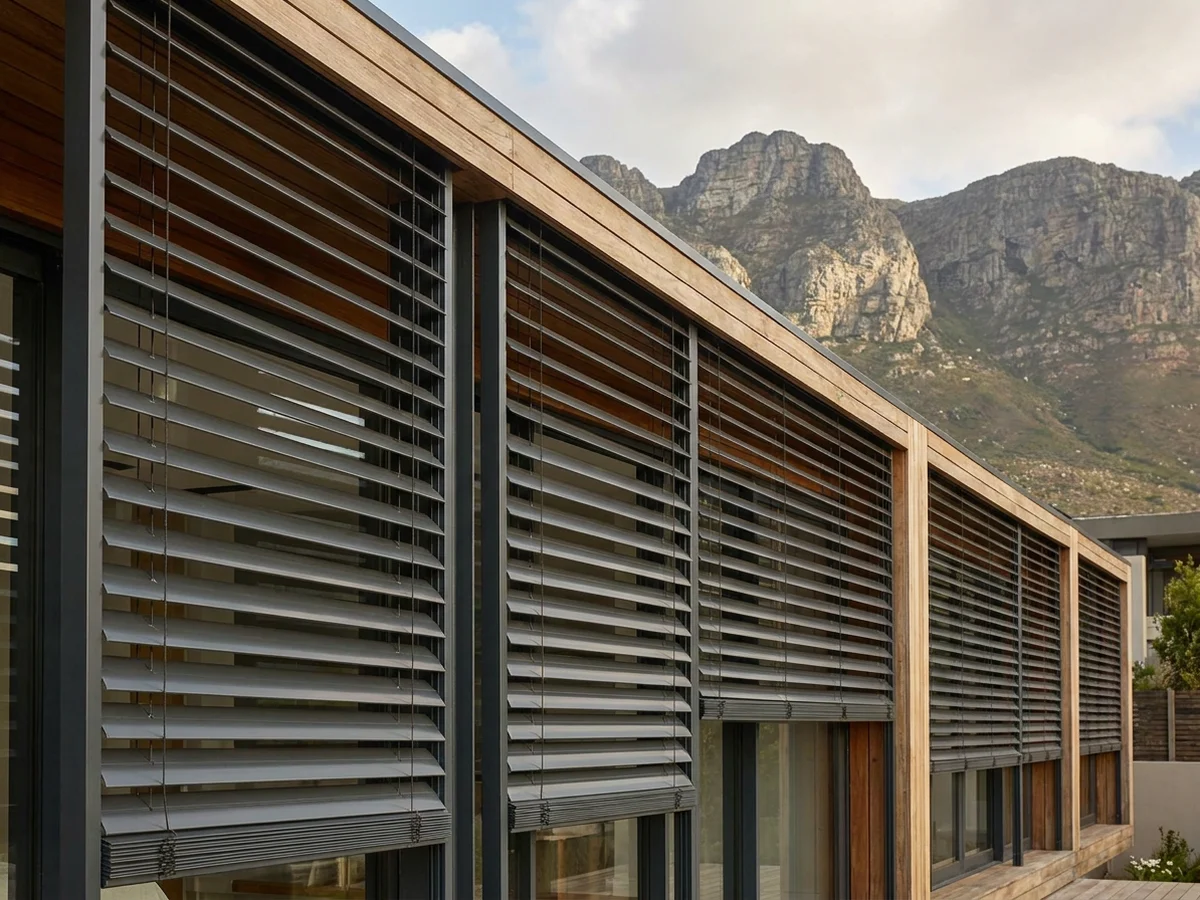
This is why external shading is the premium end of what we'd specify in Somerset West and why we lead with it on the bay-facing side. External venetian blinds hang outside the window on adjustable aluminium slats: the heat is stopped at the facade, and because the slats tilt you can keep the view running out under them while the sun is blocked above. Roller shutters — aluminium slats rolling down from an outside headbox — do the same job with a harder edge, and the trapped air behind a closed curtain of slats insulates as well as it shades. Zip screens, mesh tensioned inside side channels, are the version that also survives real wind. To be plain about it: our roller shutters are a shading product for sun, heat and glare, not a security-rated one. That's a different product and we'll say so rather than let you assume.
The honest counterweight is that all three are permanent fittings on the outside of your house, they cost more than a blind, and on an estate they need approval before anyone drills anything. Where that's not workable, an interior sunscreen or a cellular blind is the second-best answer — meaningfully less heat control, meaningfully less money, and no submission to write.
External venetians on a bay-facing wall: the slats tilt to hold the view open underneath while the sun is stopped before it reaches the pane.
The wind decides what may live outside
The Cape's defining summer wind is the south-easter, blowing hardest from roughly October through March.5 Out here at the head of False Bay, with the Hottentots Holland behind the town, it is the single fact that separates outdoor shading that lasts ten years from outdoor shading that lasts two summers.
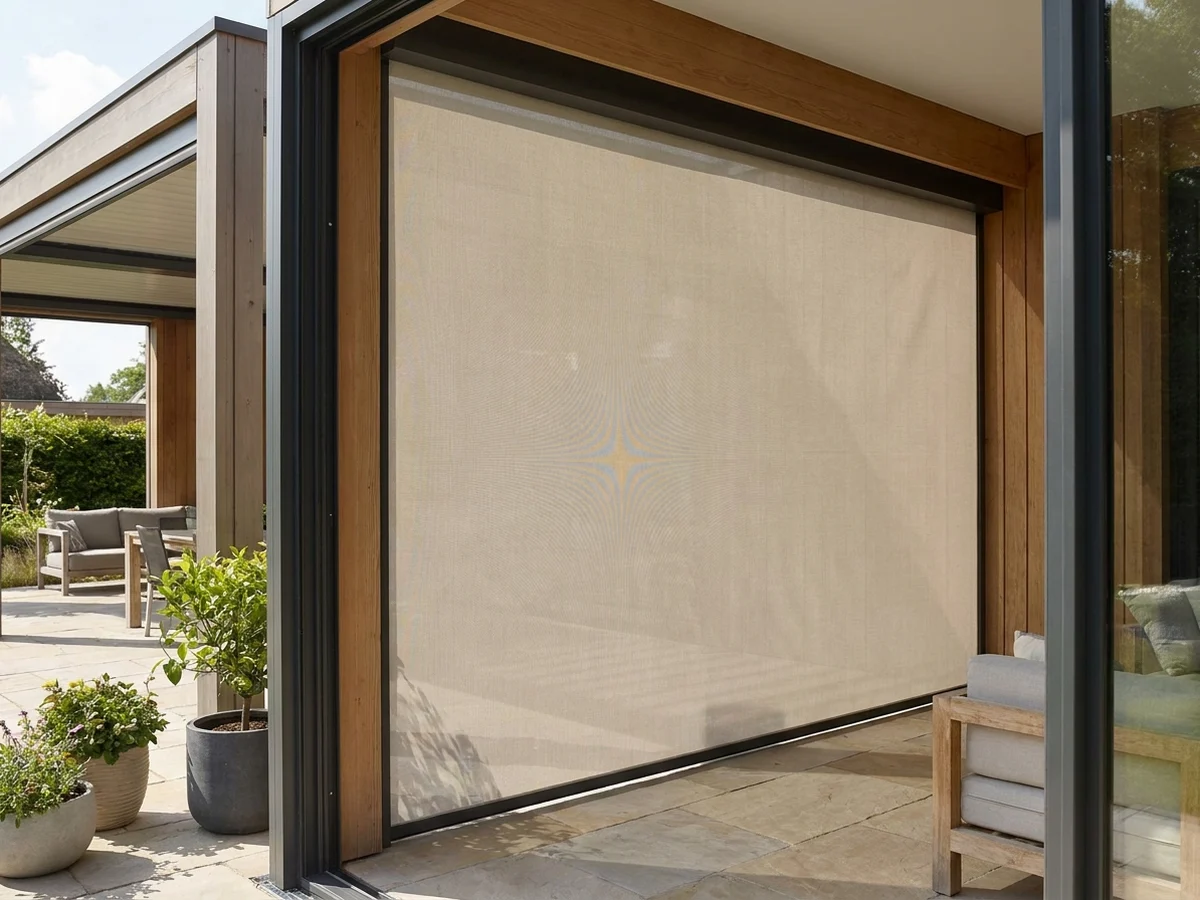
What it means in practice is short. Anything we hang outside on this side of the mountain is specified wind-rated and motorised with a wind sensor, so that it retracts itself before a gust arrives rather than after. A patio awning that has to be wound in by hand is a product that will one day be left out during a braai, and that is the afternoon it breaks. On a genuinely exposed terrace we would rather fit a zip screen than a folding-arm awning at all: mesh held in side channels handles gusts that an unsupported awning arm cannot, and it turns a windy patio into a room you'll actually use in February.
The second wind fact is the air itself. The Helderberg belt runs down to the sea, and salt-laden air is unkind to exposed metalwork and moving parts long before it troubles your plastered walls.6 The nearer the Strand end of town you are, the more that matters: powder-coated aluminium, sealed cassettes and stainless fixings are the baseline here, not the upgrade.
A zip screen closing the windward side of a patio — the answer where an awning alone would spend the summer retracted.
What goes on which wall
Take a compass through the house before you take a tape measure. Then this list stops being a catalogue and starts being a plan.
Bay-facing living rooms and the hot west wall
External venetians first, roller shutters where you also want it dark
Both stop the sun at the facade instead of after the fact. External venetians keep the view alive because the slats tilt; roller shutters give you shade, near-blackout and a real insulating layer, which suits a media room or a west bedroom better than a lounge. Motorised as standard on anything above about two metres wide.
What it costs you: the highest price in the range, a permanent fixing to the outside wall, and an estate submission if you're behind a boom.
North glass and mountain-view rooms
Sunscreen roller blinds, or a tilting slat
A 3–5% openness mesh takes the sting out of the light and holds most of the UV without turning the Helderberg into a grey blur. Where a room needs to swing between bright and private through the day, aluminium or timber venetians tilt rather than raise, which is a different and often better kind of control.
What it costs you: a mesh gives you daytime privacy only — after dark, with the lamps on, it reverses and you become the lit side. A double roller (mesh in front, blockout behind, one bracket) is the fix where a room needs both.
Bedrooms, and the east side generally
Blockout rollers — where the edges matter more than the fabric
Every blockout fabric is opaque. Almost every bedroom complaint is light leaking round the edges instead, which is why the fitting decision matters more than the fabric choice: inside the reveal looks neat and leaves a hairline each side; over the opening is far darker and covers the reveal. Day/night blinds are the middle road for a room that doubles as a sitting room.
What it costs you: there's no free option — neat, dark, or both at the price of side channels.
Rooms that run cold, and rooms that run hot all evening
Cellular blinds, where the complaint is temperature rather than light
The honeycomb structure traps a layer of air against the glass, and that trapped air is the insulation. It works both directions: a west room that's still radiating heat at seven in the evening, and a south-facing room that never warms up in July. Quiet, too — cellular deadens a room noticeably.
What it costs you: it doesn't tilt and it won't take scrubbing, so it's the wrong choice for a kitchen, a bathroom or a room where you're managing a view.
Stacking doors, gables and architect-finished ceilings
Vertical and panel blinds, concealed boxes, shaped systems
Wide sliding and stacking doors want something that clears the opening entirely — panel glides or verticals stack back off the glass. On a new build or a renovation, a concealed box drops the blind out of a slim ceiling slot with no visible hardware at all. Gable ends and angled glazing get shaped or tensioned systems made to the actual pitch rather than a rectangle that nearly fits.
What it costs you: concealed boxes are a build-stage decision and awkward to retrofit into a finished ceiling; shaped systems are made to order for one opening, so they cost more and take longer.
Patios, braai rooms and terraces
A wind-sensored folding-arm awning, or a zip screen where it's exposed
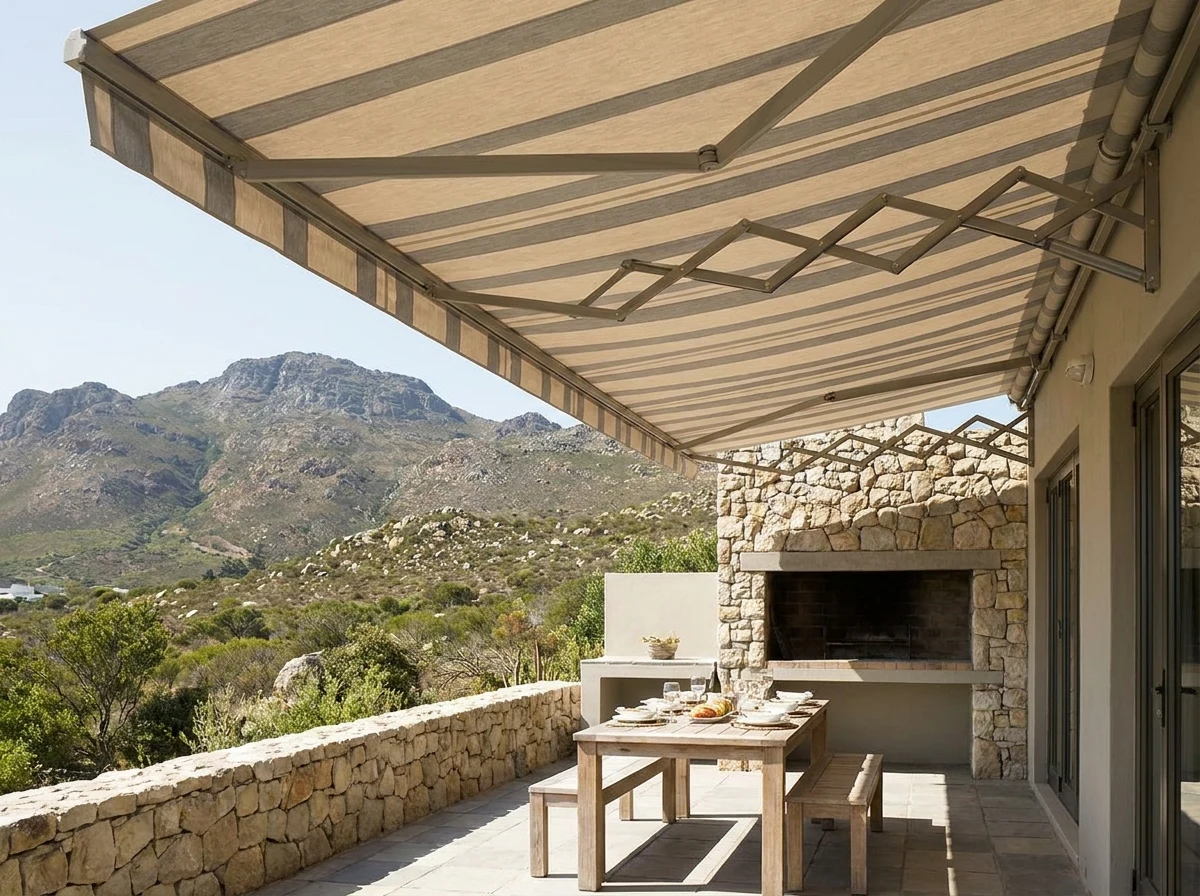
Retractable shade fits this climate exactly: cover through the hot months, gone in seconds when you want the winter sun back on the paving. Motorising it with a wind sensor is not a luxury here — it is the thing that decides whether the awning is still there in five years. On the most exposed stands, skip the awning and screen the opening instead.
What it costs you: awning fabric is a consumable and a battery tube wants charging once or twice a year. Neither product is a security product.
The awning that gets used is the one that retracts itself. A wind sensor is cheaper than a second awning.
Estates, committees and the bit nobody mentions
A large share of the homes along this belt sit inside estates that run a design-review or aesthetics committee, and those committees sign off on anything visible from outside the house — colour, profile, mounting position, awning fabric. Our own Erinvale page goes into that estate specifically; Gordon's Bay, Strand and Stellenbosch each have their own quirks.
The rule of thumb worth carrying into any conversation with us is simple: inside the reveal is a furnishing decision, outside the glass is a building decision. An interior blind alters nothing about your facade. An external venetian rail, a roller-shutter headbox, an awning cassette or zip-screen channels change what the street sees, and that is the committee's business.
What we do about it is supply the drawings, profiles, colours and product data your submission needs, and steer you toward finishes that don't start an argument. What we won't do is call an approval a formality or submit it in your name. That part stays yours.
Five things a floor plan can't tell us
Everything above follows from a compass and a map. These five don't, and any one of them can change the recommendation on the day:
True orientation, room by room. Helderberg-slope houses are usually turned to the view, not squared to the street, so you cannot read the aspect off the road — and every recommendation above depends on getting it right.
What the ridge actually blocks from your window. Two stands three streets apart can lose the morning sun twenty minutes apart. We look east from the room, not from the driveway.
What's behind the plaster. Solid masonry, brick and cavity, or a rebuilt stud wall — the substrate decides the bracket, and whether an external system is viable on that wall at all.
Your own wind exposure. A courtyard behind a full-height wall and an open terrace on the same stand behave completely differently in a February south-easter. That decides awning versus screen.
Power, and who has to approve it. Whether there's a point within reach for a motor, whether a battery tube can be recharged without a ladder, and whether your estate has a say in anything visible from outside.
That's the honest reason the measure is free and why it happens before the quote rather than after. Far better to find these out standing in the room than halfway through an installation.
When you're ready
Have someone read your actual walls
A free in-home measure, with fabric and slat samples, a compass and no obligation — then a written quote, itemised per window.
Tell us which rooms are the problem and an expert consultant will be in touch to arrange a free in-home measure and a written quote.
Perfect — thank you. One of our expert consultants will contact you shortly to confirm your free in-home measure.
Show the working
Sources
Nothing above about geography, sun angles, wind or salt is ours by assertion. Where we've drawn an inference beyond what a source states — the effect of the eastern ridgeline on first light, for instance — the text says so rather than dressing it up as measurement.
Somerset West, Western Cape — town coordinates 34°05′S 18°51′E, established 1822 on part of the Vergelegen estate, named for Lord Charles Somerset, the Lourens River running through it. en.wikipedia.org — Somerset West
Helderberg Mountain — coordinates 34°02′13″S 18°52′12″E, part of the Hottentots-Holland range, overlooking Somerset West and False Bay; the name means "clear mountain". Bearing and distance from the town centre are our own calculation from those two sets of coordinates. en.wikipedia.org — Helderberg Mountain
Sir Lowry's Pass — the N2 crossing of the Hottentots Holland mountains between Somerset West and the Elgin valley, south-east of the town. en.wikipedia.org — Sir Lowry's Pass
Solar geometry for this latitude. Noon elevations are 90° minus the latitude plus or minus the earth's 23.44° axial tilt; sunrise and sunset azimuths follow from the standard solar-position equations. You can reproduce every figure on this page for your own address. NOAA Global Monitoring Laboratory — solar position calculator
Salt air and exposed metalwork — Western Cape coastal trade sources on why exterior hardware, timber and metal need attention before plastered walls do. painterssomersetwest.com
Every product recommendation on this page is our own opinion, given free and without obligation. Nothing here is an estate-approval opinion — that belongs to your home owners' association — and nothing here is a price. Prices come from a written quote after a free measure.